By Kirsten Coachman
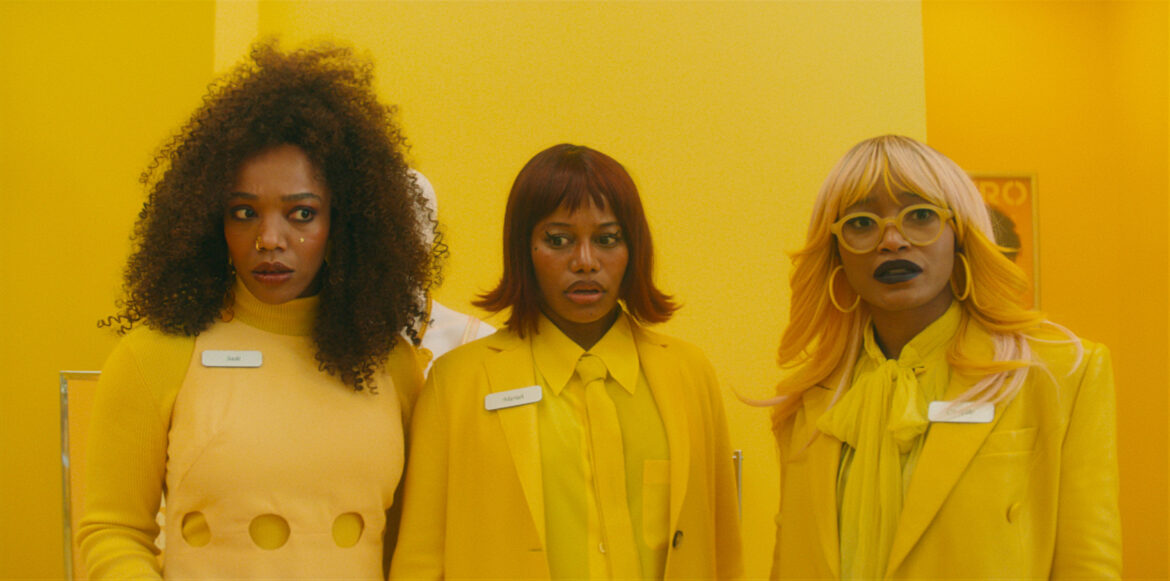
The three Fs—“Fashion Forward Filanthropy”—is the name of the game in Boots Riley’s new film, “I Love Boosters,” opening in theaters this weekend. At the center of the Bay Area writer-director-rapper-activist’s follow-up to 2018’s “Sorry to Bother You” is the Velvet Gang, an Oakland-based group of professional shoplifters—Corvette (Keke Palmer), Sade (Naomi Ackie), and Mariah (Taylour Paige)—who sell stolen designer goods at a community-friendly rate. The group zeroes in on designer Christie Smith’s (Demi Moore) monochromatic Metro Designers outlet stores throughout the Bay Area.
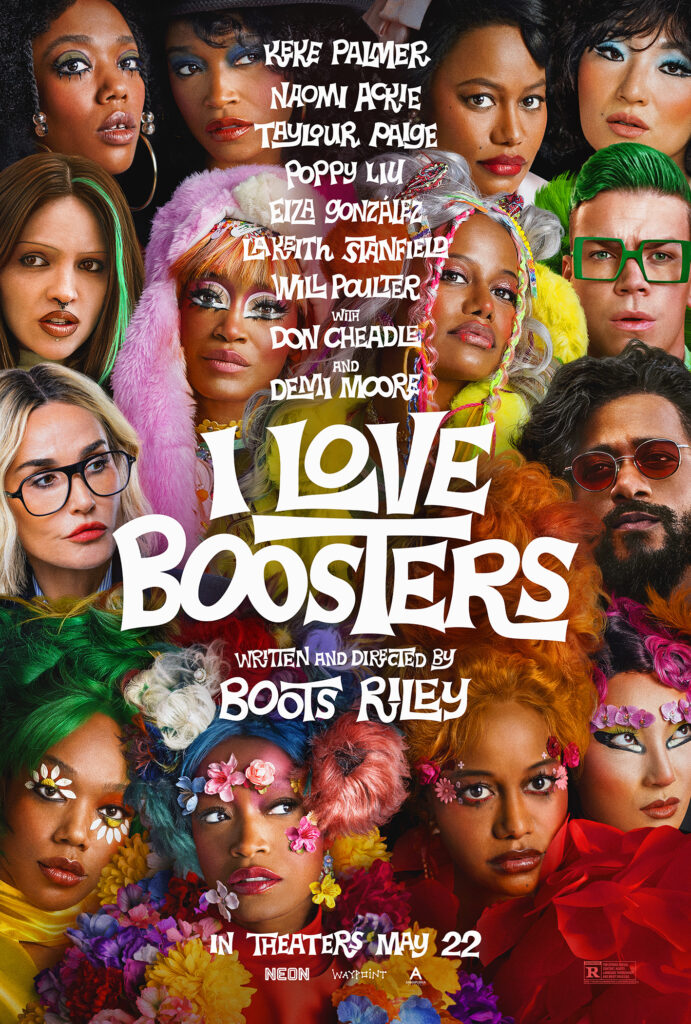
Riley’s film is striking in both style and storytelling, complemented by a catchy score by Tune-Yards. The writer-director weaves his unique creative voice and vision through fantastical worldbuilding and hilarious dialogue, riding a rousing conversational undercurrent grounded in how to create purposeful change in today’s world.
“I Love Boosters” had its Bay Area premiere at the 69th SFFILM Festival this past April, where moviegoers packed Oakland’s Grand Lake Theater. Riley was in attendance alongside actors LaKeith Stanfield (“Judas and the Black Messiah”), Eiza González (“Baby Driver”), and Poppy Liu (“Hacks”).
Art U News had the opportunity to sit down with Riley, Stanfield, González, and Liu during their San Francisco press stop to learn more about the creative process behind “I Love Boosters.” The actors shared how creative collaboration and a passion-fueled set provided energy as well as advice for our Academy of Art University students.
Speaking with Riley about his writing process, the director explained that it starts with a concept that he’s been “kicking around in my head.”
“I’m usually not gonna start doing something till I know what the ending is,” said Riley.
As it turns out, “I Love Boosters” is the result of Riley’s first-look deal he struck with Annapurna back in 2018.
“The idea behind those is you give three ideas,” Riley explained. But, instead of pitching a treatment with three potential ideas, Riley opted for a different approach.
“I was like, ‘Okay, what I’m gonna do is work out a bunch of movies, like in my head, and I’m gonna decide that there are my next moments, so no matter which one they pick, this is something,’” said Riley, who wrote the first 20 pages for each film to see what he liked. “And that way, then whatever I present, no matter what they pick, is something that I’m really behind.”
Though the film’s lens is on the fashion industry, “I Love Boosters” came together through the creation of characters that Riley wanted to work with onscreen.
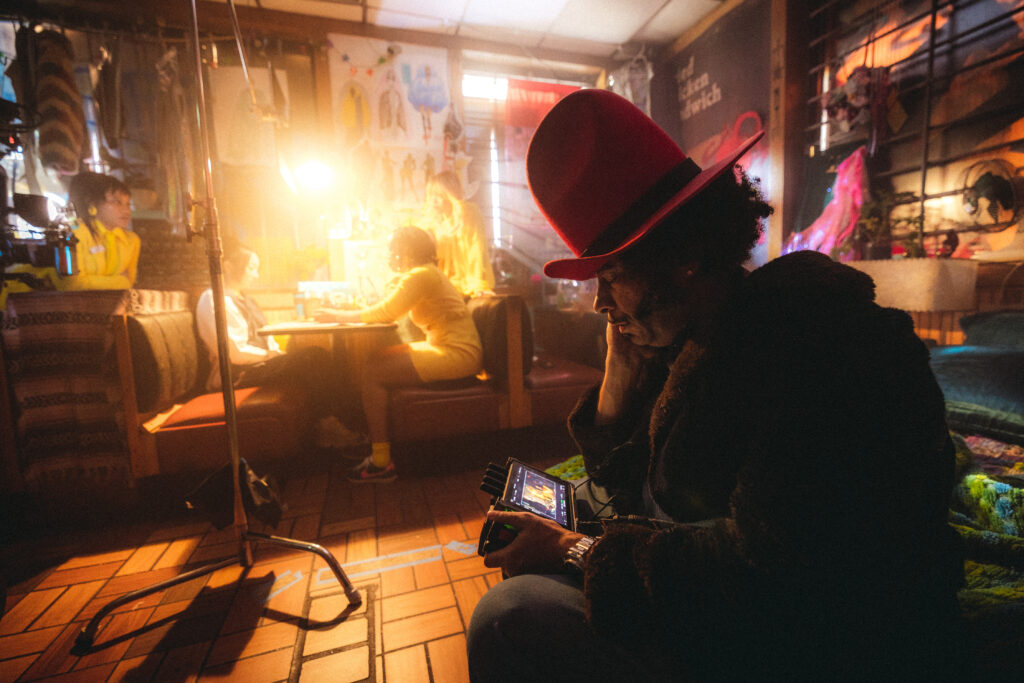
“Twenty years ago, I’d written a song called ‘I Love Boosters,’ inspired by groups of women whom I had met through all of that,” said Riley. “For those same reasons that I wrote the song, I wanted to write this. I’m always trying to think about things from different angles. I consider the character, and then I consider what do I think about the world that they’re connected to, the whole world and all of that.
He continued: “I could make a movie from that standpoint of that bus driver and think about what I think about the world and connect it to what shapes his world, or a drone driver for one of these Waymos. I could think about that, but I’m always thinking about what do I really think about the world? How do I think about what constructs the world? I think everyone does that. However, often there’s one version of the world that they’re doing, and it’s usually the version that’s in every other movie. I always say the reason it’s hard to make a movie about a communist utopia is because that’s what Disney movies are. Everybody’s got housing, everybody’s got healthcare, everybody’s got everything they need. And in most movies, like most rom-coms or whatever, there’s only a homeless person if it has to do with somebody saving them or something like that. So the world that I’m thinking of is: what is the world really? How do I show what that person’s world really is? That’s connected to ‘I Love Boosters,’ because what that person’s world really is, if you’re working in fashion, it’s not just what’s in front of their face; it’s where the thing came from.”
For his actors, being contacted about the project was, in González’s words, “always an honor.”
“You wanna find filmmakers that are pushing the boundaries and making real personalities when it comes to characters,” said González. “I always want to work with directors that don’t conform, and the obvious choice is never the obvious choice. And I find that Boots has always been that kind of director.”
Liu added, “I feel like he is pushing the boundaries of storytelling in a way where he’s like, I think, just singular in his vision. And he really is in a league of his own just in terms of genre, in terms of storytelling, voice. There’s no one you can even compare him to other than himself. You can’t even compare ‘Boosters’ to anything other than his past work, because it’s so uniquely him.”
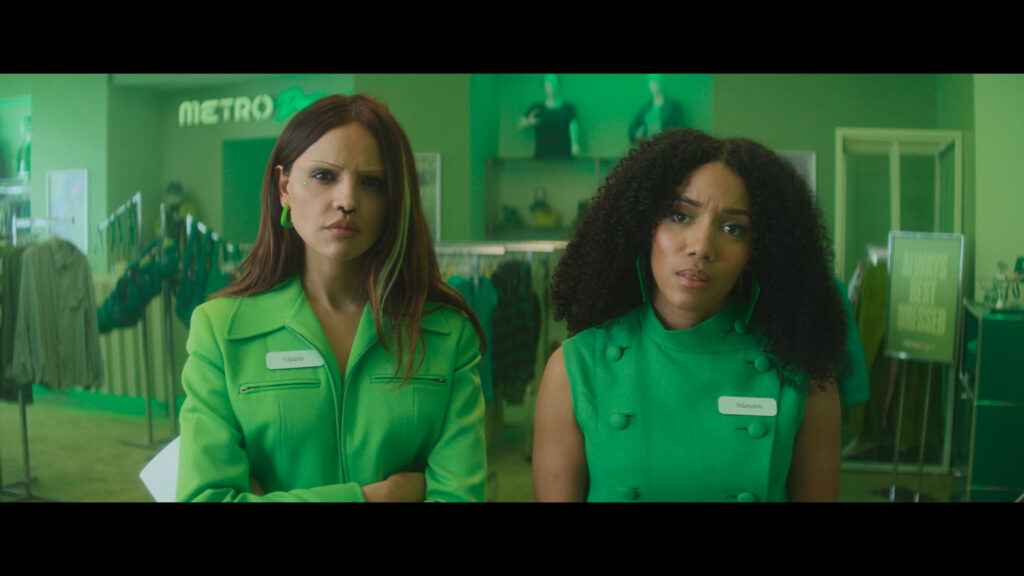
In the film, González and Liu’s characters are two sides of the same coin. As Violetta, a Metro Designers retail employee and deep-thinking stoner, González’s character deals with unfair wage compensation and criminally short lunch breaks, and in Qingdao, China, Liu’s character Jianhu copes with an ailing parent, who works in one of Christie Smith’s production factories, where employees are exposed to harmful chemicals from sandblasting denim, as well as unfair wages.
For Liu, the opportunity to portray a character like Jianhu onscreen is particularly meaningful.
“A lot of these themes are things I deeply care about,” said Liu. “I’ve performed my whole life, but for most of my twenties, I was living in New York, and I was doing a lot of organizing. I got really involved with the reproductive justice movement, a lot of Asian solidarity.”
“She really is a social justice warrior out there in the real world,” said González. “And Poppy earnestly lives it, just the same way as Boots. And it’s really inspiring. I’m sure watching her play this character feels, I mean, I don’t want to speak for you, but it really feels poignant.”
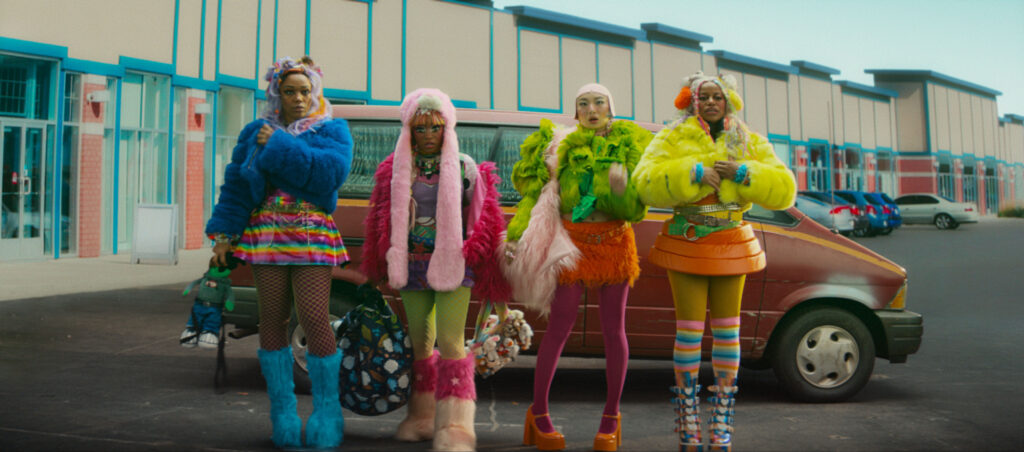
The colorful cinematic world Riley created for “I Love Boosters” features dynamic, monochromatic set pieces, which provided a certain energy to the actors when it was time to step in front of the camera.
“It puts you in a state when you’re standing in front of the camera where you’re just like, ‘I gotta do it, and I gotta commit, and I gotta go for it,’” said González. “I spent a lot of time with Will [Poulter], and he took a swing. And once you’re seeing everyone taking a swing … that makes a ginormous difference. And it’s all driven through passion. This is a small-budget movie. All those sets took a lot of people behind them and a lot of work. So we gotta deliver.”
“I feel like any still of the film is a visual masterpiece, like everything is a tableau,” said Liu. “I feel like if you watched it with no sound, no idea of the story, it is still an artistic feat. I think it’s part of the world-building of it all.”
“I Love Boosters” served as a reunion for Riley and Stanfield, who previously worked together on the director’s debut feature, “Sorry to Bother You.” The Oscar-nominated actor opened up about his experiences working with Riley on both films.
“I think the same spirit that we had there, which is that we knew we were making something special, and against all odds, we would try and see it through,” said Stanfield. “I think it was the same thing that we had here, same hunger—bigger scale—but same thing. And his level of dedication and imagination has only tripled since then.”
Both Stanfield and Riley touched on how their creative relationship has evolved since their initial collaboration nearly a decade ago.
“We’re always open to each other’s ideas, and we’re willing to disagree, but it evolved in the sense that we brought each other’s life context to it,” said Stanfield. “He and I sat down before we filmed and talked about some crazy things that we had been through and survived, and it was just great to know, like, ‘Wow, we’re still here.’ And we got through those things. And then, what doesn’t kill you? Characters, you know, you get stripes. I think that helped us, our context of life, going through things—wins, losses, helped inform who we came to the movie as.”
“He’s had a little more experience, a little more heartbreak, a little more adventure, that sort of thing,” said Riley. “Us being friends now, it’s different from our first meeting and working together. There are things that we can talk about that I know about his life that we can talk about to get into the character. It’s probably a little more trust in there. For instance, he agreed to do the part, and after a while, it was like, ‘Did you read the script?’ And he was like, ‘Yeah, yeah, I read it.’ And I’m like, ‘Okay.’ He was fully on board, deal’s made, all that kind of stuff. And then at some point, I get a text from him being like, ‘You’re crazy.’ And I was like, ‘You just read the script, didn’t you?’” [Laughs.]
In the film, Stanfield plays a model, known as “Pinky Ring Guy,” who crosses paths with Palmer’s Corvette, serving as an intriguing distraction for the ambitious and stressed-out booster. In a revealing moment in the film (no spoilers, but moviegoers will know it when they see it), Pinky Ring Guy proves to also be a booster of sorts, a takeaway we expounded upon to the actor.
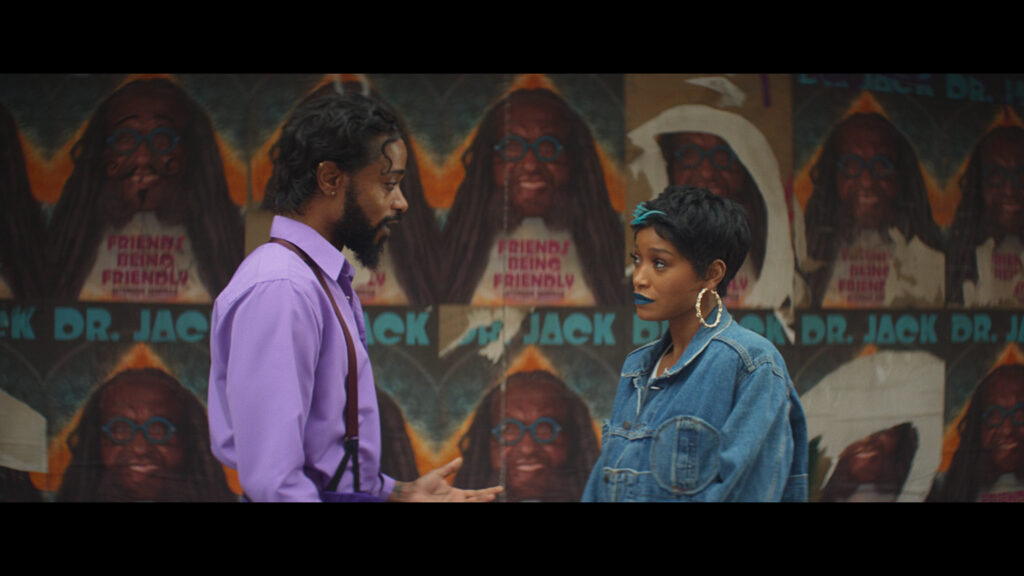
“I never even thought about that; I think that’s really quite profound,” responded Stanfield. “In every relationship, you give and take, and sometimes people are only there to take. It just seemed like he was trapped in a perpetual state of only knowing how to take, and then he met someone in Keke’s character that was different and that he really wanted to try to love, but really wasn’t ready to do so.”
When it came to his character, Stanfield wanted to give the model some distinctive qualities. “I think more interesting characters are more nuanced people who are dealing with various things, and kind of trying to be better, but they don’t know how. So I wanted to give him a little bit of elements and depth.”
And cool hair.
“I told Boots I want to do like a Johnny Depp in ‘Cry-Baby’ kind of thing, mixed with a little bit of Prince,” said Stanfield. “And so we came up with this hairstyle. I also gave him some eyeliner. I was like, I want him to feel like a rockstar boy.”
In thinking about the boldness of “I Love Boosters,” the cast shared advice for Academy filmmaking and acting students looking to step out of their comfort zones, whether in their school projects or post-Academy journey.
“Ultimately, individualism is being celebrated more than ever,” noted González. “This perfectly polished version of individuals is not interesting anymore, and I think we need to take advantage of this moment, and I think people who are new in the industry need to take advantage of this moment to explode their point of view and their artistic expression. In the world of IPs and remakes of a remake of a remake, people are craving original content. So, jump at it.”
“Before doing anything great, it’s always going to feel absolutely terrifying. It is part of the process, just as much as the great feeling from winning is part of that process, the horrible feelings of anticipation are a part of it,” said Stanfield. “I think once we accept that, then we can deal with those feelings and know it’s gonna be alright, it’s temporary. And then you get past the uncomfortable feelings, and you’re so grateful that you put yourself through it, because now you’ve uncovered something really valuable. And I think we should be accepting of uncomfortability in order to move into places. If you want to reach to reach thing you’ve never reached, you gotta feel things you never felt.”
While shooting his first movie, “Short Term 12,” in 2013, Stanfield recalled how terrified he was as a young actor stepping onto a film set for the first time.
“I just told myself, ‘Do it. And I know you’re scared, but go,’” Stanfield recollected. “And I went, and when I came to, everyone in the scene was like, ‘Wow, that was amazing.’ And I was like, ‘Who, me?’ They’re like, ‘Yeah, you, you just did that thing.’ And it took me a while to feel comfortable with the fact that I was an actor. I thought I was an imposter. I don’t know what I’m doing. At some point, I came to the realization that you gotta accept and own who you are. Sometimes you’re just that bleep.”
“I Love Boosters” is now playing in theaters.